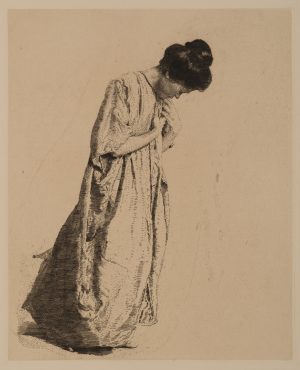
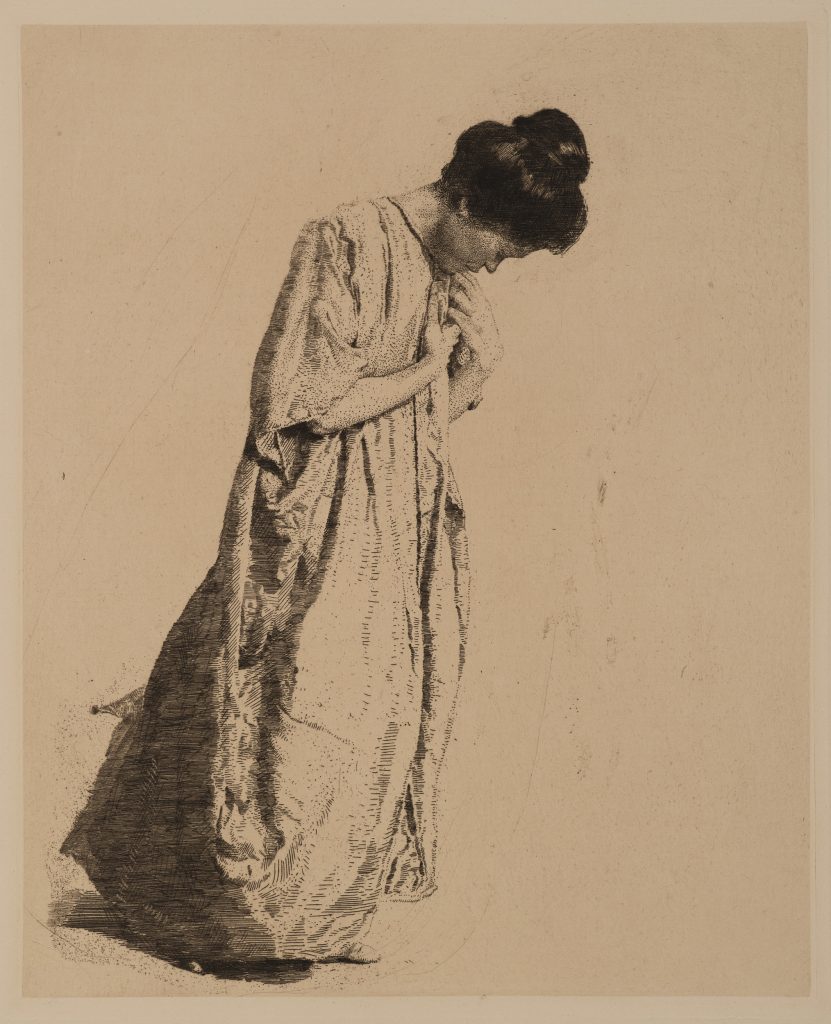
Erich Wolfsfeld
(1884–1956)
[a highly-condensed]
BIOGRAPHY OF ERICH WOLFSFELD
by Michael Mistelske - 16 October, 2019 --------- INVALUABLE KUNDE - Auction No 3, Oktober 2019
[Much more detail about the artwork of Erich Wolfsfeld is available in various publications and at various websites and through Internet research. Two very good references are:
…”The Etchings of Erich Wolfsfeld”, by Elizabeth Furness (the Belgrave Gallery, London), 1979
…”Graphiker Der Gegenwart”, by Adolf Donath, 1920
———————
Erich Israel Wolfsfeld was born in then Krojanke, Prussia…now Krajenka, Poland…, on 27 April, 1884. His Jewish parents were Moses Wolfsfeld and Johanna (Wilczek) Wolfsfeld. He had one older brother, Leo, born 21 January, 1876, and one older sister, Gertrud , born 04 December, 1881.
In 1885, When Erich was one year old, his family moved to Berlin, Germany.
Little is known of his early years, except that in 1902, at the age of 17, Erich entered studies at the Berlin Academy of Arts. At the Academy, Wolfsfeld studied drawing under Professor Konrad Bose (a follower of Adolf Menzel) and etching under Hans Meyer…becoming Meyer’s Meisterschuler and being given his own studio at the Academy, a special situation reserved for only the very best students.
In his first three years at the Berlin Academy, Wolfsfeld distinguished himself and became highly regarded, even being commissioned by the Prussian government in 1905…at only 20 years of age…to make etched copies of Byzantine frescoes in the classical ruins of Priene, Turkey. It is extremely unfortunate that there is no surviving record of these etchings, intended for publication as part of the official report on the excavation of Priene. His experiences in Turkey, however, were to profoundly influence the course of Wolfsfeld’s future travels and subject materials.
Wolfsfeld’s first published etching, in 1907, is of a small, dark “Head of an Old Man in a Fur Hat”. It is reminiscent of Wilhelm Unger’s etchings after Rembrandt, both of those artists strongly influencing Wolfsfeld’s early work. He particularly admired Rembrandt, along with Adolf Menzel, one of Wolfsfeld’s early German contemporaries. It’s a little-known fact that Adolf Menzel twice turned Wolfsfeld down when the younger man applied to Menzel for work as an assistant or as a model.
?
During his early years of association with the Berlin Academy of Art, Wolfsfeld studied under Jules Lefebvre in Paris, and in Rome he became acquainted with German expatriate artists Otto Greiner and Max Klinger. Especially during his time in Rome, Wolfsfeld produced many etchings of nudes and of beggars. Then and throughout his life, Wolfsfeld’s art reflected his respect for the poor, the humble, and the underprivileged…portraying even the most downtrodden with dignity. From his later artwork reflecting travels in North Africa, it is noteworthy that Wolfsfeld expressed the same sympathy and dignity in his portrayals of the poor among both Jews and Arabs.
In 1911, Wolfsfeld’s etching of the prior year, “The Archers”, won the Kaiser Wilhelm Gold Medal. Until that time, he devoted himself largely to etching. While he made from 20 to 100 prints of some of his etchings, it is generally thought that he made as few as just one or two prints from many. “The Archers” is known to exist in two states, as many as four states are known of some of Wolfsfeld’s etchings…each state reflecting changes or additions to the artwork. In the first state of “The Archers”, for example, only the central figure was shown, in the 2nd and final state, that central figure is flanked by two additional men. In other etchings, from one state to another, one can see where Wolfsfeld even dramatically changed or removed figures as the artwork moved toward completion.
Among Wolfsfeld’s other famous early etchings of large scale are:
…from approximately 1909, “Bound” (aka, “The Bound Man”), an almost-life-sized seated male figure,
…from 1910-1914, “Job and his Friends” and “Amor and Psyche”, each 902mm wide (Wolfsfeld portrayed many biblical scenes and scenes from mythology in his artworks),
…from 1914, his famous, “The Chess Players”, detailed typical of Wolfsfeld’s etchings, two almost-life-sized men seated in deep thought across a chess board.
From about 1912, Wolfsfeld increased his attention to painting in oil, but his energies were diverted by the outbreak of World War I. While serving as an officer in the German army from 1914 until 1916, Wolfsfeld added studies of wounded soldiers to his palette. In 1916, he was appointed to a teaching position at the Berlin Art Academy. There, in 1918, he was given a post as a professor of drawing, and two years later, he was given the prestigious position of Professor of Painting and Etching. Also in 1920, the first Wolfsfeld monograph was published (”Graphiker Der Gegenwart”, by Adolf Donath).
From 1920 to 1936, Wolfsfeld remained at the Berlin Academy of Arts, and he continued his travels extensively in Europe and northern Africa. In 1936, because of his Jewish heritage, Wolfsfeld was compelled by the Nazis to quit his post at the Academy. Three years later, in 1939, he fled to Europe. After a brief internment on the Isle of Wight, Wolfsfeld was soon accepted into the English population with a visa as a distinguished person under a cultural quota. Wolfsfeld was able to bring many of his artworks with him to England from Berlin, since he had generally painted on treated paper rather than on stretched canvas (the former being easily rolled and transported).
Erich Wolfsfeld lived in England and etched and painted in Europe and northern Africa for another 18 years. His works continued to reflect street life and street people, particularly the underprivileged and poor. Humble as they appear, donkeys were also among Wolfsfeld’s favorites, and they feature in his works from early etchings to later paintings. Biblical themes continued to be among his favorite subject materials. Some of his later paintings were quite large, up to two meters in width. Shortly before his death, Wolfsfeld was made an associate member of the Royal Society of Painter-Printmakers.
Erich Wolfsfeld’s works have been displayed in galleries across the world, and examples of his art are found today in many museums, especially throughout Europe. In 2009, 53 years after his 1956 death at age 72, a large “attic find” of Wolfsfeld’s works (by his then-83-year-old stepson), including some 100 paintings, were offered for sale at auction in England. This treasure trove had rested for over five decades, and the auctioneer described it as “…a unique collection and a rare opportunity for someone to acquire art work from one of the 20th century’s great unsung heroes from the art world.”
Another prominent art critic has described Wolfsfeld as “…one of the finest etchers of this century….” “The simple reality of what [Wolfsfeld] saw on his travels did not move him either to exaggerate or caricature his subject matter…. His compassionate vision records the dignity of peoples thoroughly accustomed to adversity. Wolfsfeld’s is an outlook with which Rembrandt himself might have sympathized…. In [oil paint] and other media, such as chalk or pen and wash, Wolfsfeld demonstrated a wonderful certainty yet fluency in his drawing…. He was an artist of rare ability.”
Other tidbits of Wolfsfeld information:
—His customary painting garb was a long white Arab robe.
—The artist, Lotte Laserstein, was his Meisterschuler.
—He was twice married, first to Ilse Fackenheim, second to Hilde Lieberg (Block).
—He had no children by either of his two marriages.
—Both Ilse and Hilde survived him by many years.
—It was a son of his second wife by a previous marriage (Block) that rediscovered the treasure trove of Wolfsfeld’s many works in an attic in 2009, 53 years after Wolfsfeld’s death.
~END~
- Tätig im
- 20. Jahrhundert
- Geboren
- 1884 in Krojanke
- Gestorben
- 1956 in London
- Werke im Shop
- 1
Verfügbare Werke